
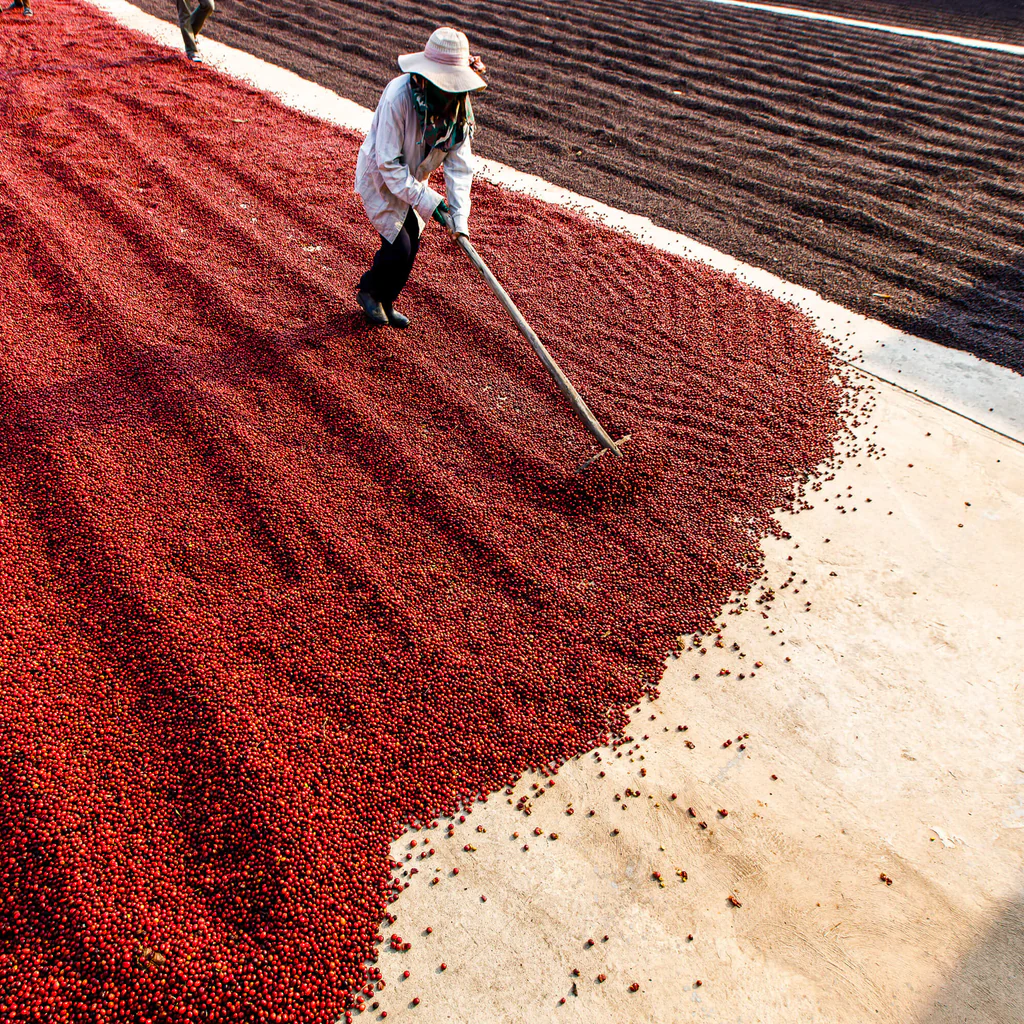
During the dry season coffee is harvested from the trees. The ripest cherries produce the finest coffee, and ripeness is usually a beautiful red.
Picking, or stripping
Once the harvest starts — usually September to March north of the equator, and April to May south of it — workers walk the plantation and take the cherries. There are two ways to do it.
Selective picking takes only the ripest cherries. It is very labour intensive; pickers often return to the same tree several times.
Stripping takes everything at once and sorts afterwards, discarding the unripe cherries or selling them separately. It is common in Brazil, where cherries mature together and the volumes are enormous.
Coffee can also be collected by machine: harvesters shake the trees.
The arithmetic
Every 100 kg of coffee cherries produces around 15 kg of green coffee. Everything else — skin, pulp, mucilage, water — is removed before the bean is dried and shipped.
That ratio is why a bag of coffee is a small miracle of logistics, and why the picking method shows up in the cup.